

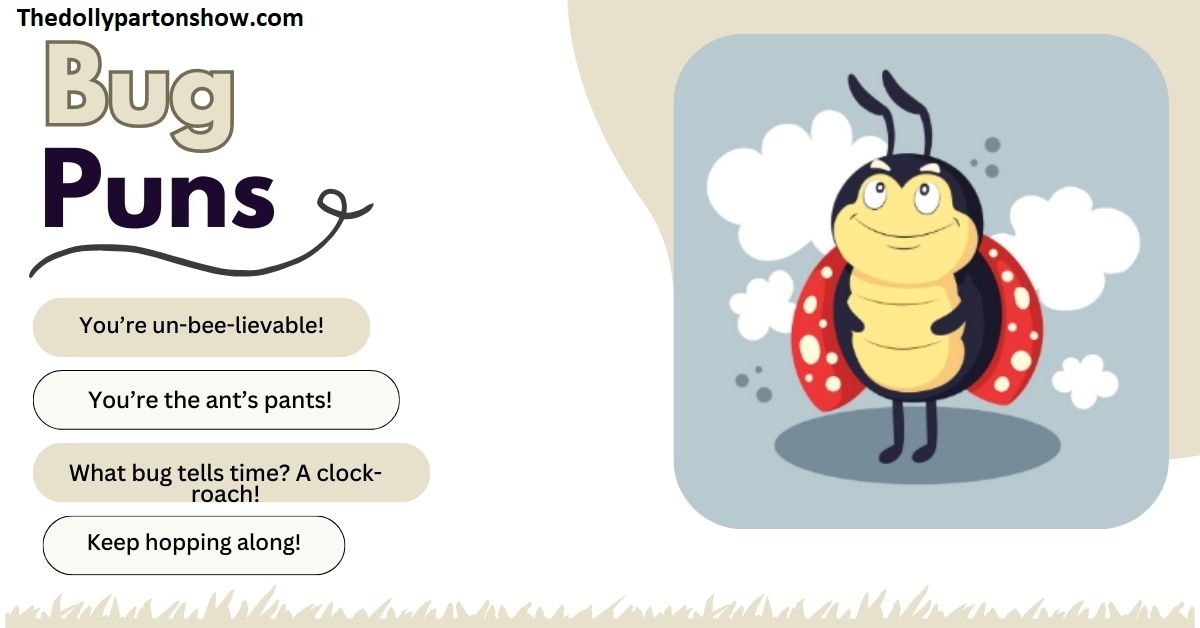
Bug Puns Life can be a little buggy sometimes, but that is no reason to flee! Whether you are feeling antsy about a deadline or just need someone to beetles your worries away, remember — even the smallest creatures carry tremendous strength.
Don’t let anyone bug you or crawl under your skin. Stand tall, stick to your goals like a walking stick, and moth-ivate yourself daily. When life gets tough, be a firefly — shine brightest in the darkest moments.
So bee yourself, wing it when necessary, and never stop buzzing toward your dreams. Life is short — make it un-flea-gettable!
Table of Contents
Quick Table
| # | Bug Pun | Meaning |
|---|---|---|
| 1 | Life is buggy | Life can be messy and unpredictable |
| 2 | No reason to flee | Don’t run away from your problems |
| 3 | Feeling antsy | Feeling nervous or restless |
| 4 | Bug you | To annoy or bother someone |
| 5 | Crawl under your skin | Something that deeply irritates you |
| 6 | Stick to your goals | Stay focused and committed |
| 7 | Moth-ivate yourself | Push yourself to keep going daily |
| 8 | Be a firefly | Shine your light in dark moments |
| 9 | Bee yourself | Always stay true to who you are |
| 10 | Un-flea-gettable | Something truly unforgettable and special |
What Is Bug Puns?
So here’s a weird confession: I got deep into bug puns because of a camping trip gone slightly wrong.
We were somewhere in the Catskills — me, three friends, a questionable tent, and approximately six thousand mosquitoes. By night two, after slapping ourselves raw and running out of repellent, we gave up fighting and started naming them.
Then we started joking about them. Then someone made a truly terrible pun about a ladybug and we all lost it. Exhausted, itchy, and slightly delirious — and we were laughing harder than we had all weekend.
That camping trip taught me something real: a good bug pun lands differently than most humor. There’s something uniquely satisfying about the cringe-meets-clever thing they’ve got going on.
They work at kids’ birthday parties, they work in group chats at midnight, they work slapped on a coffee mug for the entomologist in your life. They’re weirdly versatile.
So I’ve spent a genuinely embarrassing amount of time collecting, categorizing, and testing bug puns on real humans. Here’s everything I’ve learned.
Why Bug Puns Hit Different
Before we get into the good stuff, let me explain why this category of wordplay has its own special magic. Most puns play on similar sounds — homophones, near-rhymes, double meanings.
Bug puns do all that, but they also have this extra layer: bugs themselves are inherently a little funny to people.
They’re small, they’re weird, they gross some people out, and they have absurdly dramatic names (bombardier beetle? mantis shrimp? those aren’t real).
That pre-existing comedy baseline means a bug pun doesn’t have to work as hard. You’re already halfway there just by saying “caterpillar.” The pun is just the cherry on top.
There’s also the coding world angle. If you’ve spent any time around software developers, you know that “bug” — meaning a glitch in code — opens up a whole second universe of puns.
Tech humor and entomology humor overlap in a Venn diagram that is funnier than it has any right to be.
“I told my code it had a bug. It said, ‘I prefer the term ‘undocumented feature.'”
Classic coding / bug crossover · Works at every stand-up meeting, allegedly
The Big List: Bug Puns Worth Saving
I’m going to break these down by occasion because context is everything with puns. A killer pun in the wrong room is just a cringe moment.
Classic one-liners (for the group chat)
“Bee yourself — everyone else is taken.”
“I’m rooting for you. No wait — I’m beetling for you.”
“Don’t worry, bee happy.”
“What do you call a bee that’s having a bad hair day? A frizz-bee.”
“Ant you glad I didn’t say banana?”
“I’m feeling a little fly today.”
For the software developer in your life
“It’s not a bug, it’s a feature with extra steps.”
“Found a bug in the system. Named it Gerald. We’re bonding.”
“My code has one bug. His name is Kevin and he refuses to leave.”
“Debugging: like being the detective in a crime where you’re also the murderer.”
Romantic (yes, really)
“You must be a firefly, because you light up my world.”
“I’ve got a crush on you — and I’m not a praying mantis about it.”
“Are you a bee? Because you’re un-bee-lievably cute.”
“I’ve been buggin’ about you all day.”
Kid-friendly (classroom gold)
“What do you call a bee that lives in America? A USB.”
“Why don’t ants get sick? Because they have tiny ant-ibodies.”
“What do you call a fly with no wings? A walk.”
“Why did the fly never land on a computer? Too many bugs already.”
How to Actually Write a Good Bug Pun (Not Just Recycle Old Ones)
Here’s where I went from someone who enjoys puns to someone who makes them up on the spot. It’s a learnable skill, I promise — and it’s more fun than you’d think.
Step-by-step process
- Start with the bug’s name, not the joke.Pick any bug — firefly, weevil, termite, aphid, silverfish. Write it down. Now stare at it until your brain starts breaking it apart into sounds. “Termite” = “terminate.” “Weevil” = “we-vil” = “evil.” “Silverfish” = already contains “fish” and “silver” — double opportunity.
- Find the double meaning.Ask yourself: what else does this word (or a similar-sounding word) mean? “Beetle” sounds like “beat.” “Fly” is both a bug and a verb. “Bee” sounds like “be.” “Ant” sounds like “aunt” or shows up in words like “antsy,” “fantastic,” “elegant.”
- Build a setup that earns the punchline.The best puns feel inevitable — like the listener could almost see it coming but still gets surprised. A setup about a bee giving career advice earns “just bee yourself” better than saying it cold.
- Test it on one person first.Not a group. One person. Watch their face. The involuntary grimace followed by a laugh is a green light. Just the grimace means go back to step 1.
- Know when to stop.The hardest lesson. One bug pun is charming. Four in a row is a bit. Twelve in a row is a hostage situation.
The best bug pun I ever wrote: “I’ve been going through a metamorphosis lately — just waiting for someone to notice the butterfly energy.” Took me about 45 minutes in the shower. Worth it.
Where Bug Puns Shine (And Where They Flop)
I’ve deployed bug puns in a lot of contexts at this point — birthday cards, science class presentations, client emails (once, as an experiment), wedding toasts, and one truly memorable entomology club meeting where I was briefly considered a legend.
Here’s my honest breakdown of where they land:
They absolutely work
- Kids’ content — a child hearing “What do you call a bee that’s always complaining? A grumble-bee” will lose their mind. Always.
- Science teachers and nature educators — bug puns are memorable hooks that stick in students’ brains next to the actual information.
- Birthday and greeting cards — the low-stakes format means even the groan reaction is affectionate.
- Social media captions — “just bee-ing myself” next to a garden photo will get engagement. It’s annoying, but true.
Mistakes I’ve personally made
- Using bug puns in a formal presentation without reading the room first. My audience was a group of pharmaceutical executives. Nobody laughed. I said “this whole project has really been buggin’ me” and then had to continue for 22 more slides.
- Explaining the pun after nobody laughed. Rule of comedy: if you have to explain it, you’ve already lost. Just move on. Pretend it didn’t happen. We don’t talk about the weevil incident of 2023.
- Stacking three puns in one email. I thought it was charming. My colleague said it felt like “being trapped in a novelty calendar.” Point taken.
Tip from hard experience: If you’re sending a bug pun in writing — a message, email, card — always include a small self-aware note like “I’m not sorry” or “I’ll see myself out.”
It signals that you know exactly what you just did, which transforms the groan from awkward to affectionate.
The Surprisingly Rich World of Bug Pun Communities
I know how this sounds. But there are corners of the internet where people take this seriously — in the best, most wholesome way possible.
Reddit’s r/puns has entire threads dedicated to insect wordplay. Teachers on Pinterest have built whole classroom theme boards around bug humor.
There are entomology educators on YouTube who pepper their videos with puns specifically because they’ve found it keeps middle schoolers engaged through the harder material.
It works. Science communicators like to say that a good laugh creates a memory anchor — you remember the content because of the emotion attached to it.
There are also novelty shops on Etsy absolutely full of bug pun merchandise — mugs, tote bags, enamel pins — that do genuinely good business.
“Just here for the bees” and “I find this very in-sect-ing” are apparently on enough water bottles to fill a small warehouse.
If you want to really go deep on entomology humor, the National Geographic Kids site has some solid family-friendly material. And honestly, any field guide to insects doubles as unintentional comedy just from the bug names alone.
Who named the “biting midge”? Someone who wanted to be accurate and unsettling at the same time.
A Few Personal Favorites I’ll Stand Behind
After testing approximately one million puns on unsuspecting friends and family, these are the ones with the best track record:
“I’ve been going through some changes lately. Real caterpillar-to-butterfly stuff. Still mostly just eating leaves though.”
Metamorphosis pun · Works for life updates, Instagram bios, therapy humor
“My friend told me to stop making insect puns. I said, ‘I can’t help it — they just bug me.'”
The classic self-referential bug pun · 9/10 on the groan-to-laugh ratio
“Asked my therapist if I was making progress. She said, ‘You’ve really come out of your shell.’ I reminded her I’m not a snail. She said, ‘We’ve been at this for three years and I had to try something.'”
Extended bug/nature pun · For written format only — needs the setup space
Making Bug Puns Your Own
The thing about pun humor — and I realized this slowly, through a lot of camping trips and awkward silences — is that it’s a form of connection. A shared groan is still a shared moment.
The eye-roll someone gives you when you say “bee-utiful” is an affectionate one. It says: I know what you’re doing, I see you, and I’m rolling my eyes with love.
That’s what made those two nights in the Catskills funny despite everything. We were miserable and covered in bites and we chose to laugh at tiny flying things instead.
A bug pun in the right moment is basically a small act of resilience — proof that humans will find a way to be ridiculous even when the mosquitoes are winning.
So go ahead. Use the puns. Make up your own. Test them on your least-suspecting coworker. Put one in a birthday card. Name a mosquito Gerald.
And if anyone complains? Just say you’ve been going through a real metamorphosis lately, and this is who you are now.
Frequently Asked Questions
What are bug puns?
Bug puns are clever wordplays that use insect-related terms and names in humorous or meaningful ways. They take familiar bug vocabulary — like bee, ant, flea, moth, and firefly — and creatively apply them to everyday life situations for laughs, motivation, and lighthearted entertainment.
Where can I use bug puns?
Bug puns are perfect for social media captions, greeting cards, classroom activities, nature blogs, children’s books, and casual conversations. They add a fun and creative twist to any content, making it more engaging, shareable, and memorable for audiences of all ages.
Are bug puns suitable for children?
Absolutely! Bug puns are completely family-friendly and wonderfully educational. They help children learn insect names in a fun and interactive way while developing a love for wordplay, creative thinking, and humor from an early age.
Can bug puns be used for motivational content?
Yes! Bug puns blend humor with inspiration beautifully. Using insect metaphors to deliver life lessons — like the firefly shining in darkness or the ant staying committed — makes motivational messages more creative, relatable, and enjoyable to read and share.
How do I create my own bug puns?
Start with common insect names and terms — bee, ant, flea, moth, cricket, beetle, fly — and think about how they sound like or relate to everyday words and phrases. The more unexpected and clever the connection, the funnier and more memorable your pun will be!
Conclusion
Bug puns remind us that humor can be found in the tiniest corners of the natural world. Insects have long been overlooked and underappreciated, yet they carry some of the richest material for wordplay, creativity, and laughter.
From the busy bee to the glowing firefly, the world of bugs offers an endless supply of inspiration for anyone willing to look closely and think cleverly.
Beyond the laughs, bug puns carry real wisdom. They teach us to bee ourselves, to moth-ivate through challenges, and to shine like a firefly even when life feels overwhelmingly dark.
There is something beautifully simple about finding life lessons in the smallest creatures on earth — it grounds us, humbles us, and reminds us that greatness often comes in the most unexpected packages.
Whether you are a writer looking for creative content, a teacher searching for engaging classroom material, or simply someone who loves a good laugh, bug puns deliver on every level.
They are fun, family-friendly, and surprisingly profound when you stop to think about their deeper meanings.
So the next time life feels a little too serious, remember to stop and appreciate the bugs — they have been trying to make us smile all along.